
Let me start by clarifying what the title of this post means by “The Divinity of Purpose”. I don’t mean divinity in the classical religious sense; I mean it in a more metaphysical sense. To help me explain, I’ll quote from the Wikipedia page for Divinity:
Among the Greeks and Romans, divinity was not confined to a rigid theological system. Gods, heroes, and even emperors might be described as partaking in divinity, just as natural forces or virtue could be seen as expressions of divine essence. Philosophers such as Plato and the Stoics used the term to refer to the soul of the cosmos or the rational order of the universe, while ritual and myth depicted the divine in vivid ways. To call something divine was not always to worship it as a god, but to acknowledge its participation in a higher, sacred order.
See, I’ve spent my life trying to find what my purpose is, and over the last few years, I’ve found more joy in the idea of helping others through sharing my ideas and utilizing technology, and more specifically, freedom technology to achieve that goal. That’s not to say there aren’t tradeoffs, things still need funding, and I believe that my years of studying outside the box thinking like Navy SEALs, working as a business owner, and now years within the corporate world have all built up to give me the tools to utilize open source and artificial intelligence (A.I.) to not only achieve what I now realize has always been my core drive, but ways to fund and manage the process.
So what is my purpose?
Well, first, a quick background. I love dogs, and I had a golden retriever named Lucy. On the morning of September 9th, Lucy was lying behind me when she suddenly vomited. I cleaned everything up, took care of her, and once I thought she was ok, tried to give her some breakfast of chicken and rice. Now Lucy loved chicken and rice, but this time she flat out refused, so I called the vet and got her in about two hours later. They ran tests and couldn’t find anything, so they gave her some anti-nausea medication and sent her home.
24 hours later, she was still refusing to eat and had lost the ability to support her own weight on her hind legs, resulting in her wetting herself when I tried to help her up. So I called the vet again, and they made an emergency appointment for her, and I carried her to the car, then drove to the vet, who helped carry her in for further testing. The vet ran more tests and couldn’t find anything, and had me take her to an animal hospital in a relatively nearby town.
The animal hospital took her into the ER and started running tests, finding nothing, so she was transferred to the hospital’s intensive care unit. Lucy spent 4 days in the intensive care unit getting every test they could think of and medication they could safely try. After 4 days in intensive care, the fever she had been running was getting worse; she hadn’t eaten more than a few spoonfuls of peanut butter, she had completely lost bladder control, and could only sit up on her front legs for about a minute before they gave out. So on day 4, Sept 13th, the doctor sat us down and said 4 doctors, an ultrasound tech, and a surgeon have all worked on her case, and no one can figure out what is causing her illness, she is suffering, and we can’t stop it.
So the worst decision had to be made, and after spending time lying on the floor petting her and talking to her, the signal was given, and we said goodbye to Lucy at the age of just 9 ½ years old. While losing Lucy was the worst by far, it was compounded by not knowing what led to all this happening. In a desperate attempt to save her, I authorized every test, no matter the cost, even when they warned me the chance of finding an answer was slim to none. The only thing that wasn’t authorized was exploratory surgery since the surgeon who worked with the ultrasound tech said he saw nothing that would warrant surgery, and in her state, he doubted she would survive any surgery of that kind.
Side note: I keep switching between “we/us” and I/me” that is because Lucy was my dog, but I’m single with no kids I’m currently living with my mother and helping her around the house, and Lucy and my mom were big part of each other’s lives, so my mom was present for everything and helped explain medical terms to me since she’s a retired nurse, but the financial decisions and final decision were my responsibility.
After a few days, we received her ashes, and that did bring some closure, but still, we are left with the mystery of what caused the illness that led to her death. It’s an answer we most likely will never get, and that leaves added pain. Now that it’s over, I’ll admit I’m not sure if I want to know, since if it was something that could have been cured, I’d live with that knowledge and guilt, even though there was no way to know at the time.
Ok, I know I said “quick background”, so I’ll leave it there. So what is my purpose? Even after getting the closure that receiving her ashes brought, I was still left with the nagging issue of what caused this to happen. So one night, a few days into being back at work (I had taken time off throughout this process, vacation days be damned, Lucy was my priority), I was listening to a podcast about A.I. and a discussion about how medical researchers were using A.I. to find answers to medical questions that they couldn’t figure out.
This got me thinking, and I started researching for veterinary researchers using A.I., only to find that while there are some, there’s no broad project to collect and unify data across domains. As far as I could tell, there are just pockets of data collection and research being done by independent or, sometimes, a few collaborative universities. But what is missing is a unified database for larger datasets, and mass data collection from veterinarians to build larger datasets.
This is my purpose: to build an A.I. dataset and tools for researchers and veterinarians to find answers when testing doesn’t provide answers. To bring these parties together to collect and analyse data for researchers to find connections they wouldn’t otherwise find, and to help veterinarians find answers for their patients and assist in alerting them to warning signs for illnesses before the doctors are aware of them. Let’s face it, veterinarians have a tough job; their patients can’t tell them what’s hurting, and they are by their nature prone to hide pain and illness until it’s so bad they can’t hide it. Not only does an A.I. have the ability to continuously analyze data for researchers, but it can also analyze data for individual patients and make an already stressful and tiring job of being a veterinarian and make it just a little bit easier, and in the process, preventing unnecessary pain and suffering of beloved pets.
What I envision is a GPT built on patient data from all parties, on which custom GPTs are then built on top of. Researchers could build GPTs for the diseases they are focused on, and a prebuilt GPT could be offered for veterinarians that would ingest their patient data on an ongoing basis and assist them both by offering alerts and through queries. Of course, research papers and results would be added to this dataset to allow others to build on the work, and to allow the system to build connections that humans would miss or at least not see for some time. Throughout all this, all data would be fed back into the main core dataset to build it and allow for greater understanding and identify trends to help stop them before they get out of control, and allow researchers to begin studying the problems sooner.
Steps, of course, would have to be taken to anonymize the data, but the core data, animal type, breed, gender, age, medical procedures, drugs given, ongoing medications, ect. would all be included, while names of the pets and owners would be removed. The only identifying data that I would argue should be included is the names of the research facility or veterinary clinic. I say this because if contact needs to be made between professionals to aid in helping a patient, that should be something that should be easy to do with this tool. I do understand that this would be a no-go for some, so I would say make sharing the names of the research facility or veterinary clinic an opt-out option during enrollment, with the option to opt back in at any time.
Everybody needs a profit motive.
I’m sure there are people in the A.I. space that will look at this and say, “Hey, that’s great, but all that compute has to be paid for somehow.” This is where my work history comes in. I’ve had a variety of jobs, but the last few were self-employed courier / online sales, I worked as a dispatcher for a small air freight company flying domestically and internationally (U.S. & Canada), and I currently work for a Fortune 500 ground freight company with a focus on the U.S. & Canadian border. Obviously, I’m not listing the names of my employers or the companies I contracted with, as this is my own work and not associated with them.
So what does that have to do with anything? Take a look at my post “The Customs Standardization Group”. The summary of that is that there are very vague standards when it comes to paperwork. This lack of standards leads to costly delays for all parties involved, and sometimes fines for not catching mistakes, including something as simple as a commodity description. Fun fact, did you know that simple everyday shipping terms such as tool, part, NOI, FAK, and many others being transmitted to Canadian customs will result in the carrier being fined? So you have many shippers thinking these are acceptable terms to use on their shipping documents, and carriers have to employ dedicated personnel just to correct these entries before they are sent to customs brokers and government agencies for clearance. Not only is there at least one dedicated person for this task, but the people processing the documents for transmission to the brokers also have to update commodities when they spot one of the ever-growing list of fineable words.
There is also a lack of understanding of the basics of shipping documents. I can not tell you how many times I’ve seen shippers send only a Bill of Lading (BOL) and then get mad when their shipment is being held while we try to get a Commercial Invoice (CI) from them. Or sometimes will only include the first page of a CI because they put the summary on page one with a total value, but then left off the five pages of details that the broker requires to be able to process their shipment. I could go on, but I think you get my point: just because someone is a shipping manager doesn’t mean they understand the ins and outs of the international shipping world like someone who works in it every day does.
And here’s the thing, they can’t stay up to date. My employer has a team of people whose job it is to stay up to date on these things and pass guidance on to the rest of us, and sometimes, they will tell us one thing is required on Monday, and then by Thursday, it’s not required. It’s a constantly evolving landscape that is difficult to keep up with in the best of times. It’s not realistic to expect thousands of shippers, both large corporations and small enterprises, to employ a team of people who are focused on staying up to date on all these things.
This is where A.I. comes in; not only can A.I. keep up with all these ever-changing rules, but it can automate the document process. This would have to be done by a large A.I. company with enough compute to handle the task. Personally, I’m a fan of OpenAI, and since they are looking for ways to generate income without raising rates on customers, I would think this would be a good way to at least put a dent in that goal. But it could be done by Google Gemini, or Project Prometheus, among others.
So what would this look like?
Well, first, I would say train the model on proper shipping document standards for each mode of transport, you want to ensure it has a good base layer of data. Then teach it to scan for updates from all the governing agencies that it will hold standards for. I would say the best approach would be to start with one mode. I’ll use ground freight since that’s what I’m most knowledgeable about, and teach it everything you can about the mode and how to stay up to date. Once you’ve gained an understanding of this process, you can bring in teams who specialize in each mode and have them train the model on their modes of transport.
Now that you have the model built and tested, you would begin to build the shipper User Interface (UI). This would be where the shipper would input the order data, and the A.I. would build the correct shipping documents for them that meet rules and regulations. Now here’s the part that makes this an even sweeter deal for shippers, you also build an inventory management program that ties into the shipping program, so all stock is kept up to date, and shippers never have to cancel an order or refund money for delayed shipping.
Next, you build A.I. processing software for carriers and brokers. This would have their rules and standards input at the time of setup and would connect with each other and shippers for a purely digital document process. Of course, you will have to build in a feature for both that would allow manual processing of documents for shippers that aren’t using the system, but carriers and brokers would be encouraging their customers to use the software since they would be paying customers, and the shippers would be able to use the basic suite of software for free.
Then, of course, there’s the customs agencies. The system would be built to work with their existing systems at first, but over time, it would prove itself, and systems would be prebuilt and maintained for them that would be a drop-in replacement for their current software, which would then tie into the network of existing users while still allowing for non-users to interact with it.
But what about the consignee (the person or company receiving the freight)? This is where it all comes together. You build a system similar to the shipper’s system, but it tracks orders and has its own inventory management system that can, with user permission, order new stock from shippers, ensuring they never run out of the product they need.
Now all these systems talk to each other and keep each other up to date on rules and regulations, while also tracking shipment statuses and keeping every party informed. But here’s the part you may have missed: you just created an end-to-end chain that can place and fulfill orders, and in essence, you just created a marketplace. If you add in a marketplace frontend and payment processing, you’ve got a revenue stream. Now you’ve built a marketplace that makes ordering and fulfillment easy, and as word spreads, more people will want to get on board to take advantage of the growing marketplace. Basically, you’ve just created an A.I.-powered private Amazon for B2B sales, or a fully integrated Transport Management Systems (TMS).
The cost of compute and file storage
The cost of compute and file storage will be a major factor to consider. A service as I’ve described is going to require a good amount of compute to work, and while some will require access to cloud resources, the general day-to-day work could be handled by a local model. This local model wouldn’t have to be the most advanced model either; it would need conversational skills outside of answering basic questions, and it wouldn’t need to do deep research or image generation. Plus, there is always the more powerful core model in the data center that local models could offload work onto when the user requires more than a local model can provide.
So how do you get shippers and other users to host a local model? Once again, going back to my post, The Customs Standardization Group, you build hardware for the customer that has everything they need to get up and running. They would get a desktop-sized machine for a smaller operation, or a server with remote terminals for larger and multi-site operations. What you also include in this hardware is storage, so that the customer stores their own files on site. This allows for reduced costs of storage, and a selling point of “you control your data”. All the A.I. company has to do is offer a compressed backup service for a small fee.
This follows the same logic as having employees work from home, the employee provides their own workspace, internet, electricity, heating and cooling, water, toilet paper, hand soap, ect. And the best part is the employee is happier and thinks they are getting a great deal, while the employer is saving money. This same psychology is at play by providing hardware to customers, they get a reliable shipping platform that works even when their internet is out (it would just queue up shipments and queries for transmission for when the internet comes back) and they feel like they are being more secure by hosting their data locally, all the while the A.I. company is saving more on compute and storage and being thanked for it.
An open network with secure data
There are many players in this space at the moment, but the clear leader at the time of writing is their own EDI (Electronic data interchange) network for the transmission of these files. The problem is that to access their far-reaching network, you have to employ their software, which puts limits on their network’s use, as some may not want to be locked in or may not be able to afford their services. This is where open standards and protocols come in. By embracing openness and allowing others to build on the network you create, you encourage its use and adoption. Just look at Bitcoin, for example, it is built on an open protocol that many people have built their projects on top of and have increased its adoption. And what does it take to join the Bitcoin network? A simple piece of software to host a wallet that is freely available. And look at Bitcoin now, it went from completely worthless in 2008 to over $120,000 in mid-2025, and thousands of projects have been built on top of the Bitcoin protocol, enhancing its value even more.
What do I propose for this amazing open standard for EDI transmission of shipping documents and messages? A two-part system that works together to allow secure messages and file storage. What I have come upon is Nostr and IPFS.
Nostr (Notes and Other Stuff Transmitted by Relays) is a decentralized messaging protocol at its core. But it can be tweaked to allow the creation of a new private network for the shipping industry with just a bit of work. Every server and on-site piece of hardware would act as a relay, passing messages in an encrypted format that only the parties authorized to view could see.
IPFS (InterPlanetary File System) is a distributed file storage protocol that could be used to host shipping documents and other related files. Each user would host their own files and then share those files with only the parties allowed to access them, thereby giving them copies of the files as well.
So how would this work? The consignee (receiver) places an order with the shipper through the network via Nostr message, and the A.I. on the consignee’s end provides all their information that would be needed. The shipper then creates the shipment, allowing their A.I. to fill in all the documents in accordance with rules and regulations, and transmits the shipment via Nostr message to the carrier along with an IPFS link to the shipment documents. The Carriers A.I. then finds the best time for both pickup and delivery and schedules a pickup date and time via Nostr message, and the shipper A.I. accepts the date and time via Nostr message. When the shipper’s acceptance message is transmitted, the A.I. would also include the listed broker so that they would receive the documents. The carrier then picks up the shipment and scans the barcode to mark an event that says they have taken custody of the shipment, which is added to the shipment history stored in the Nostr message history. The broker A.I. is at this time also processing and accepting or rejecting the documents and adding that event to the message history. If the carrier or broker has an issue, a message is sent to the shipper A.I. to have it corrected, and all parties are notified to ensure a shipment is not moved prior to being cleared.
Once the Carrier and broker A.I.’s have accepted the documents via Nostr message, the broker A.I. would transmit the request for clearance message to the border agencies A.I. The border agency A.I. would inspect the documents and, if accepted, transmit the acceptance message along with the transaction number or other related acceptance data back to all parties via Nostr message. Now the carrier A.I. sees the customs clearance and marks the shipment as allowed to move. Now the carrier loads the shipment on the mode of transport and moves the shipment to its destination, and delivers the shipment. When the delivery is made, the carrier again scans the shipment and marks it as delivered, which creates an event on the Nostr message that is visible to all parties involved.
All parties have secure visibility into the progress and receive alerts if they are required to take action, and all documents are stored securely and shared securely peer-to-peer via IPFS.
The key to this is creating this network as an open standard, again looking at my Bitcoin protocol example, by letting others freely use your network to build on, you create an ecosystem that you benefit from, along with everyone else. I would recommend publishing this network under the GPL (GNU General Public License) so that others can both build on it and improve on it while ensuring that any party wishing to privatize it is met with legal implications. And this doesn’t mean that I want to put the current market leader out of business, far from it, as the current leader in this space they could adopt this standard and grow it even quicker by offering TMS software and related services that far outpace the free alternatives. The key is being willing to see the future and evolve fast enough to become an industry leader. I would say the A.I. company that builds this should partner with the current market leader to roll out the protocol and give it a huge boost from the start.
Back to my purpose
So I started all this talking about what I felt my purpose was: to create an A.I. for veterinary researchers and clinicians to use to help animals and ease suffering. Here’s the thing: I have this nasty habit of living indoors and eating, and sadly, those things cost money. I work 40 hours a week, plus I have to take care of things at home; all that doesn’t leave much time for research and writing for this blog, let alone for tackling such an ambitious project as I’ve laid out in the above two ideas. So what do I think is the answer….well, it’s going to sound bad, but hear me out, I want to bring back an old system that funded creatives and allowed them to bring new ideas and discoveries to the world.
Patronage
Yep, the old Patron system, but with a new twist. Patronage is the support, encouragement, privilege, or financial aid that an organization or individual bestows on another. Basically, what I’m envisioning is a non-profit that is set up and the wealthy, and corporations then create accounts with. Now they find a creative that they want to encourage and offer them a spot in their part of the non-profit. Once the amount to be paid is set, they each sign a contract stating they are contracted with the person or company to work on a project and will receive X amount from the fund. The reason I think a non-profit or some other vehicle should be set up rather than the person or company funding the creative directly is that I’m based in the USA, and health insurance has to be taken into account. By setting up a formal organization that the creatives can become a part of, they can also be granted access to group health insurance.
If you’ve read through this blog, you’ll know that I think differently, and that’s not just in how I approach ideas. I also look at life differently when it comes to money. Do I play the lottery in hopes of winning? Yep. But I know I don’t need all that money and have already created a plan for if I were to win, how I would divide up the money, and guess what, I’m only planning on living on a few million via dividends. Basically, I’m not impressed by the luxury mansions and sports cars; I just want a nice 3-bedroom house on a small plot of land, and not to have to worry about how I’m going to make the payments. My plan involves parking 5 million with an asset manager to give me $260,000 after taxes every year and putting the rest into a non-profit that would fund other non-profits and create businesses that would be owned by the non-profit to generate more cash flow and allow it to do more good. Just take a look at the screenshot below to see a sample of my plan for 5 million. Yes, I’ve planned out for between 1 million and 12 million, but I think that 5 million is the sweet spot for me.
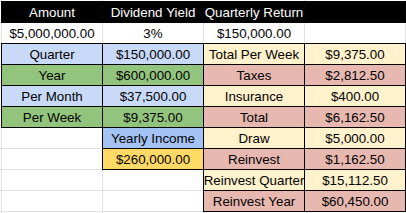
As you can see, this accounts for taxes and health insurance. Now, if this 5 million were put into a patronage fund that offered health insurance, I could take that out of the equation, and even more could be reinvested. Why the reinvestment? To keep up with inflation. And yes, I know the dividend yield is only 3%; that is intentional. I’m operating on a worst-case market scenario, and any asset manager worth their salt should be able to maintain at least 3%.
So this gives a wealthy individual or corporation a one-time investment in an ongoing return, which is placed in a non-profit, so it’s tax-deductible. And the investor, person or corporation, has the ability to end the patronage contract and not risk losing their investment since the non-profit that they placed the money into holds the funds and not the person they are investing in. And yes, I know there are rules that state a certain amount of money held in a non-profit must be distributed, and by cancelling a contract, that money would cease to be distributed, but the investor could just pick a charity or something else they wish to fund to replace the creative until they find a new creative to fund.
There is also the idea of a “think tank”, as I wrote about in my post “Multi-Domain Think Tank (MDTT)” you could, instead of setting up a non-profit, set up a think tank that would employ the creative. This would eliminate the required distribution, and the funds invested could be held and grown while the person or company looks for a creative to invest in.
Obviously, I would prefer a wealthy individual just give me the 5 million to place with an asset manager I trust, and then say ok, now create! (and if you’re out there, feel free to get in touch). But I understand the real world and know that an investor wants assurances, and this is the best way I can think of to allow that. For example, let’s say OpenAI were to like my idea and enter into a patronage agreement with me, I would insist that I continue to be allowed to post ideas on this blog, not related to either of the ideas mentioned above. This would be hammered out in the contact negotiation. If we are unable to find an agreement that suits both parties, we will go our separate ways. If we can find a middle ground, great.
So why engage in patronage at all? I’ll use myself as an example. I work a full-time 40 per week job, plus have a personal life that I have to attend to. While I can’t do anything about the personal life matters, getting that 40 hours per week back to research and write would allow me to work on so much more. Right now, I have to try and fit in research and writing into an hour here or there, and a few free hours on weekends. And I’m not the only one, of course; plenty of people who could contribute massive leaps forward are currently burned out by their job and life and don’t have the time or energy to put forth the effort to develop their ideas, and thus those ideas are lost altogether. This is why I suggest patronage; it allows the creative to focus on developing their ideas and takes away the overhead of having to earn a living. Sure, they have to put something out there first to get noticed, but once they get noticed and are able to focus on their ideas, they could create world-changing ideas.
Conclusion
So there it is, a unified A.I. powered dataset for veterinary researchers and clinicians, an A.I. powered open source secure messaging and data transfer system, and a way to fund the creatives who could create and contribute to these and other ideas.
For more ideas related to this post, check out these posts:
- Collective Intelligence
- The Internal Outsider
- Why do innovators leave?
- Embrace difference to enhance your business
- Evolve or Die
- The Employee Venture Fund
- The 6 Types of Working Genius
- Multi-Domain Think Tank (MDTT)