Key Take Aways
- Importance of Organizational Cohesion: The article emphasizes that when teams or departments work against each other, it can lead to failures in achieving internal goals and meeting customer expectations.
- Consequences of Lack of Cohesion: A lack of cohesion can result in the creation of siloed groups within an organization, which over time can lead to significant failures.
- Need for Balance: Achieving a balance between individual needs and the needs of others is crucial for organizational success.
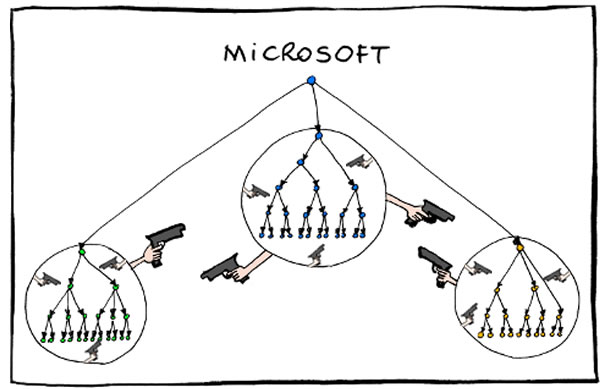
This month I want to talk about organizational cohesion. Having teams or departments working against each other can lead to failure. Failure for internal goals, and failure to meet customer expectations. Failing to have a cohesive business unit that works to support each other may seem like a minor issue now, but those failings will add up over time. First, it will create siloed groups within your organization, and those silos will lead to failures in customer service which will lead to the customer taking their business to a competitor.
Examples
I’m going to base this on three departments, Operations, Sales, and I.T. Now I’ve been self-employed and had to do all three of these roles running my business, but in the corporate world, I’ve only worked in an Operations role. So that being said, I will be basing my examples on how it affects the Operations department.
Example #1
The operations department uses a piece of software to process customer orders, this software is running on 20-year-old code, lacks needs features, and has connectivity issues. Operations goes to I.T. and ask if they can redesign the software to update it with the needs features and upgrades they need. The I.T. department says they don’t have the time to do such a major redesign. So the operations department looks around for a third-party software developer and contracts with a company that has a proven track record and 24/7 on-call support.
The third-party contractor brings in a team, finds out what operations needs, verifies that they can integrate with the current system, and delivers a contract to begin work. Then I.T. steps in and says that the third-party software will not work with the exciting system and vetoes the contract. Management then agrees with I.T. and kills the project.
Now not only has I.T. refused to build the needed upgrades in-house, but they have refused to allow a third party to build and integrate the needed upgrades. So what you are left with is a crippled operations department who feels that the I.T. department is the enemy, and they feel that their management team will not stand up for them leading to mistrust and the possibility of higher turnover.
Proper handling
Operations followed proper procedure, they first requested the needed upgrades from I.T. who said they were unable to provide them, so they then contracted with a third-party contractor who said they could provide them. Once I.T. vetoed the third-party contractor management should have stepped in and said “You said you were unable to provide these upgrades, they said they are able, you had your chance and you passed on it, now you will work with the contractor and integrate their system into ours. If you are unable to do so we will find someone else who can.”
It is the management team’s role from the lowest team lead to the CEO to take charge and issue orders, by letting I.T. kill the project the management team has abdicated their power. When the third-party contractor has looked at the system and confirmed that they could integrate with the exciting system and the I.T. department says they can not, then it is up to management to question the I.T. department’s role in the organization and inform I.T. of this question. After all the I.T. department works for your organization, you make the rules….don’t you?
Example #2
Operations processes an average of 1500 orders per day, 75% of these orders are daily repeat customers. One customer continually fails to provide a needed document resulting in the order being delayed and other parts of the operations department having to reach out to the customer on a daily basis to obtain the needed document. Rather than working directly with the operations department which they have been contacted by every day, the customer reaches out to their sales rep within your organization to request that when the operations department contacts them to request the needed document they also include an attachment of the sales receipt that they provided to operations.
So the sales rep reaches out to operations management and relayed the request from the customer, operation management informed them that they do not have time to send an attachment for every order. Sales, not wanting to lose the customer and by extension their commission, pushes back and insists they operations provide the attachment. Operations gives in and says for every order they will have their team take a screenshot of the sales order and paste it into an individual email along with the order number that they were already providing to the customer.
Now the operations team, who is already struggling to meet quotas and fulfill customer orders, is forced to take time away from other customers’ orders to satisfy one customer request that no other customer is making. And now management has been seen to give in to sales rather than stand up for their own team, leading to mistrust, apathy, and possibly higher turnover.
Proper handling
When the customer reached out to the sales rep rather than the operations department, operations management should have requested a meeting with sales and the customer to discuss their needs and how this request was burdensome on the operations team. operations management should have explained how this was burdensome on them, how the order number should be sufficient as it is for all other customers, and then negotiate for a better solution that works for all parties.
If all other customers can find the needed documents based solely on the order number then there is no reason this customer can not also find the needed documents based on the order number, especially if they are a major corporation. It is management’s role to not only stand up for their team but to negotiate with other departments and customers to find solutions that work for all parties. Sometimes this will mean that the customer is not 100% satisfied, sometimes this means that a small burden is placed on the operation team. But allowing undo burdensome requests to to placed on the operations team is a failing of management.
Conclusion
These are just two hypotheticals that illustrate what I’m trying to get at with this post. Each department’s management needs to stand up for their team both internally and externally. That isn’t to say you can’t find solutions that work for all parties, that should always be the ultimate goal, but sometimes that is going to ruffle some feathers, but that is what it takes sometimes, “He who has no enemies has not made progress”